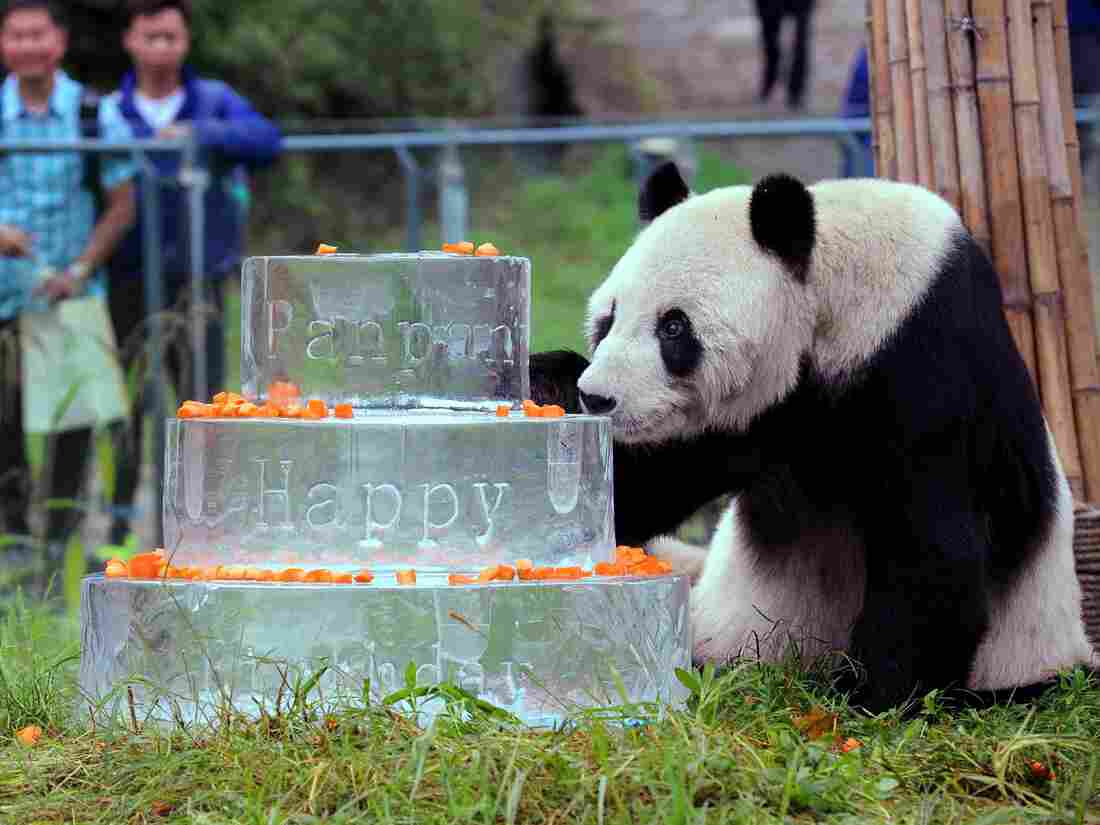
This picture taken on September 21, 2015 exhibits big panda Pan Pan sniffing a birthday cake product of ice for his 30th birthday on the China Conservation and Analysis Centre for the Large Panda in Dujiangyan. AFP/Getty Photos conceal caption

This picture taken on September 21, 2015 exhibits big panda Pan Pan sniffing a birthday cake product of ice for his 30th birthday on the China Conservation and Analysis Centre for the Large Panda in Dujiangyan.
AFP/Getty PhotosWithin the closing days of a 12 months that has turn into identified for quite a lot of superstar deaths, 2016 struck once more. The Chinese language state information company Xinhua reported this week that what's considered the world's oldest male panda has died in China on the age of 31 — round 100 years previous in human years.
Pandas are notoriously troublesome to breed, however Pan Pan was identified for his virility. He has been dubbed the "panda grandpa" for his many offspring. Pan Pan first turned a father in 1991, and in line with stories, now has greater than 130 descendants populating zoos worldwide, accounting for 25% of the world's captive pandas. The Smithsonian Nationwide Zoo presently has three of Pan Pan's descendants: Tian Tian, who's Pan Pan's son, and Bao Bao and Bei Bei, his grandchildren.
Earlier this 12 months the large panda was faraway from the endangered species listing because of Chinese language conservation efforts. Jianguo Liu is a scientist at Michigan State College who works on sustainability, and he says that's excellent news for pandas, however the work is way from completed.
"I believe the pandas in captivity and within the zoos will likely be useful to coach individuals concerning the significance of conservation," Liu says. "I believe they don't seem to be in battle, and I believe they're to a big diploma complimentary," he provides of breeding packages and conservation efforts. Nevertheless, defending the surroundings stays much more important for conservation than breeding pandas in captivity.
"We take note of the pandas in captivity like Pan Pan," Liu says. However, "It is vital to remember, local weather change is the long run menace to the pandas sooner or later." The Worldwide Union for Conservation of Nature warned in September that local weather change is projected to eradicate 35% of the pandas' bamboo habitat within the subsequent 80 years.
"The [Chinese] authorities has made an enormous effort to attenuate deforestation, to reforest, to plant bushes and defend the pure forest," Liu says. "That is nice. However that is not sufficient." He provides that the entire world, not simply China, should make addressing local weather change a precedence if the conservation effort is to achieve success long run.


No comments:
Post a Comment